
Is Your Greatest Strength Holding You Back?
Here’s How to Make a Subtle Shift—Without Losing Yourself
When Your Superpower Starts to Work Against You
You get things done. You hold it together. You figure it out.
But lately… something’s off.
What used to be your superpower? It’s stopped working. Maybe it’s even working against you.
That relentless drive that once got results now just feels relentless.
Your steady calm gets mistaken for coldness.
Your deep care is met with distance—or worse, silence.
I learned this the hard way in my own relationships. The same traits that shaped my career—empathy, listening, insight—began creating distance with the people closest to me. They didn’t feel supported. They felt… psychoanalyzed.
Maybe you’ve had your own version of this:
✔️ Self-reliance becomes isolation
✔️ Taking charge becomes overpowering
✔️ Empathy turns into people-pleasing
✔️ Attention to detail becomes nitpicking
✔️ Passion starts to feel like pressure
✔️ Calm gets mistaken for indifference
✔️ Ownership turns into micromanaging
It’s not that your strength is wrong. It’s that it’s overused.
The shift begins with noticing. And then? Learning how to shift.
Why High Performers Get Stuck
When your usual strengths stop working, it’s easy to default to one of two options:
Stay stuck in your default mode
You double down on what’s familiar—even if it’s no longer effective.Swing to the opposite extreme
You try on a version of yourself that feels fake, forced, or just “not you.”
Neither one feels right.
That’s why so many smart, capable people end up feeling gridlocked.
A Smarter Framework for Recalibrating: The Door #3 Model
When your superpower stops working, you realize you need to do something different, but what if the only alternatives seem wrong, extreme or fake? It’s easy to either freeze and get stuck — or overreact and swing to the opposite extreme.
That’s why I created a tool I call The Door #3 Model:
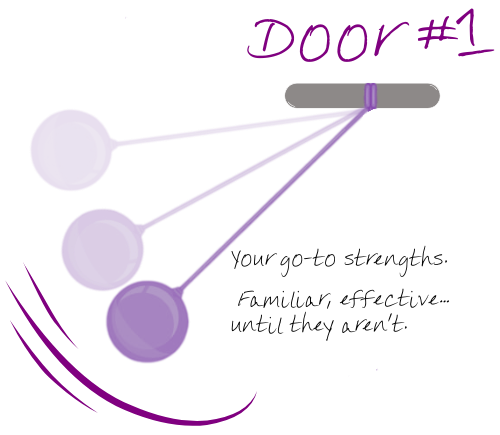
Door #1: Your go-to strengths. Familiar, effective… until they aren’t.
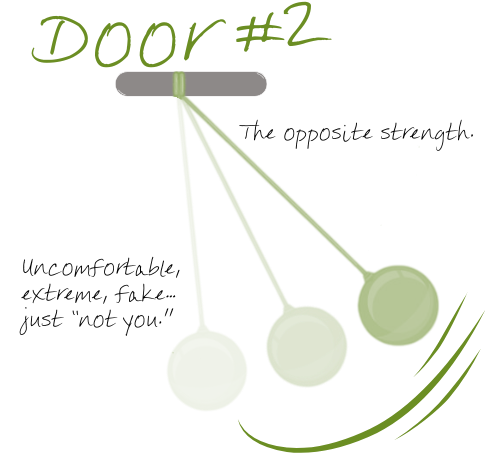
Door #2: The opposite strength. Uncomfortable, extreme, fake… just "not you.”
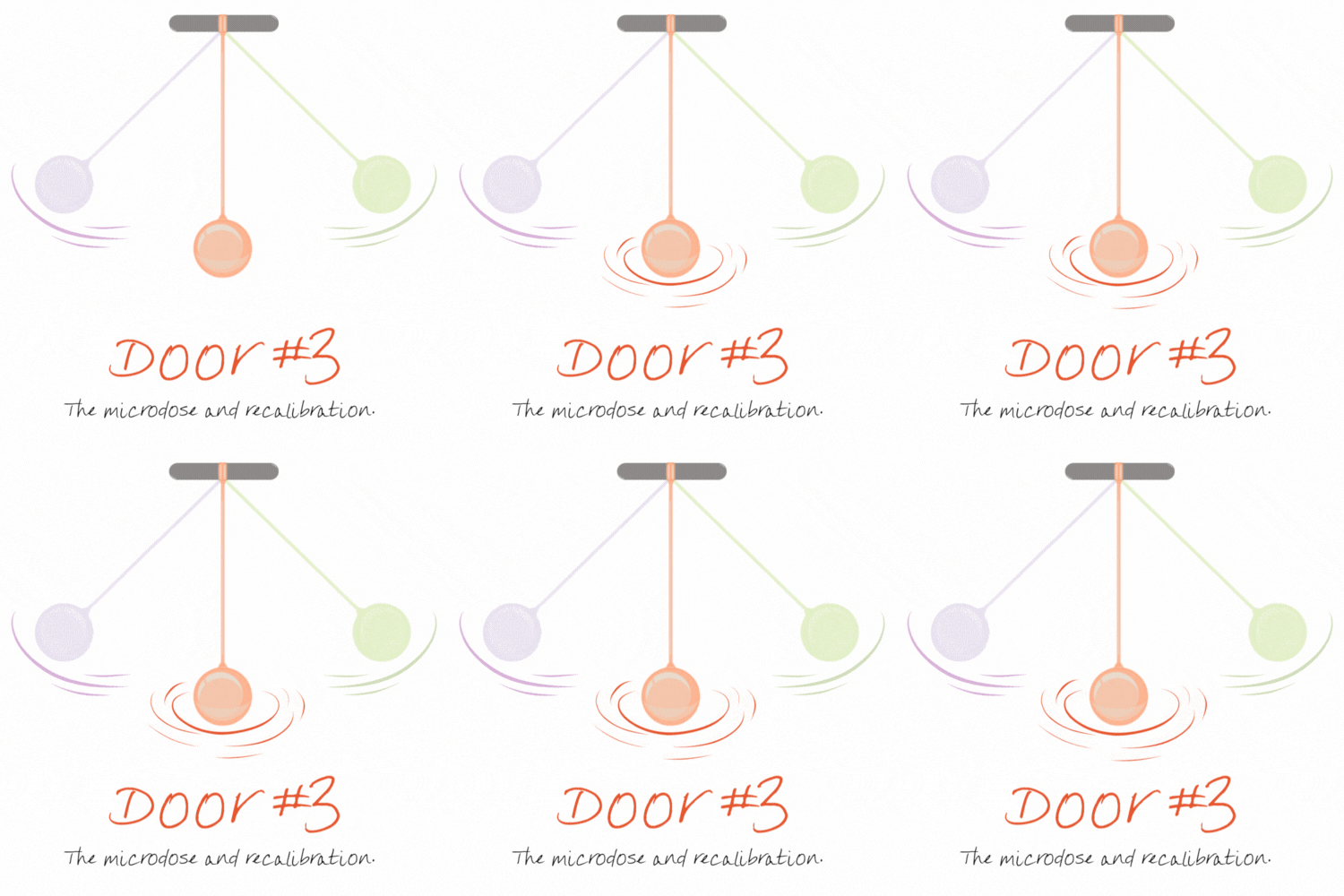
Door #3: The small but powerful shift: A micro-dose of Door #2… Just enough to be effective, without feeling fake or freaking you out.
Door #3 is a micro-adjustment. A smarter setting on your internal dial. Not a reinvention—just a recalibration.
A Real-World Example: The Med Student Who Found Her Voice
A brilliant medical student came to me after she failed to match into her dream specialty.
“Everyone thought I’d get it. I thought I would, too. But the feedback? ‘Your interview was lackluster.’”
She was stunned.
Her strengths—humility, quiet competence, thoughtful precision—had carried her far.
But in a 15-minute high-stakes interview? They weren’t enough.
She felt stuck between two options:
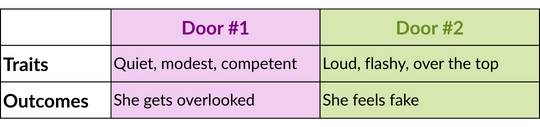
Neither felt right.
Opening Door #3:
I asked her to fill in the blanks: “In this situation, I want to show up as someone who is ____________, ____________, and ____________—just enough to be effective without feeling fake.”
Her Door #3:
“In this situation, I want to show up as someone who is confident, passionate, and engaged—just enough to be effective without feeling fake.”
Once she stepped into that mindset, her voice changed.
Not arrogant. Not over the top.
Just present.
She got the residency.
Why Door #3 Works
Door #3 isn’t about “fixing” your personality.
It’s about activating a part of you that’s already there—but underused.
It’s sustainable: You don’t have to fake it or burn out trying to maintain it.
It’s strategic: You choose what the moment calls for—and access it with intention.
It’s rooted in authenticity: You’re not becoming someone else. You’re expanding your range.
Try It for Yourself
You don’t need a personality overhaul. Just curiosity—and the willingness to experiment with something slightly different.
✍️ Journaling Prompt:
What’s your Door #1? Your default strengths. Your usual mode that gets results.
What’s your Door #2? The traits you avoid because they feel WRONG, BAD, OR FAKE:
Now envision your Door #3: What’s a micro-dose of Door #2 that still looks and feels like you?
“In this situation, I want to show up as someone who is ________, ________, and _______—just enough to be effective without feeling fake.”
Examples:
Modest → Quietly confident
Controlled → Calm and emotionally present
Empathetic → Compassionate with clear boundaries
Driven → Purposeful, without pushing
This isn’t performance. It’s presence—redefined.
One Small Shift Can Change Everything
Whether you’re facing:
A high-stakes meeting where you need to show up with more presence
A strained relationship where your usual calm lands as coldness
A family rift where over-caring starts to backfire
Door #3 offers a way through that doesn’t require shouting—or shrinking.
You don’t have to be someone else.
You just need to access more of yourself—the parts that have been underused, overlooked, or shut down.
Final Thought: You Don’t Have to Choose Between Staying You and Growing
We often think growth means abandoning who we are.
But real growth? It’s becoming more of who you already are—on purpose.
Door #3 isn’t a makeover. It’s a mindset shift.
Not too much. Not too little. Just enough.
Ready to Find Your Door 3?
If your strengths are starting to feel like they’re working against you, you don’t need a total reset.
You just need the right guide—and a smarter way to shift.
