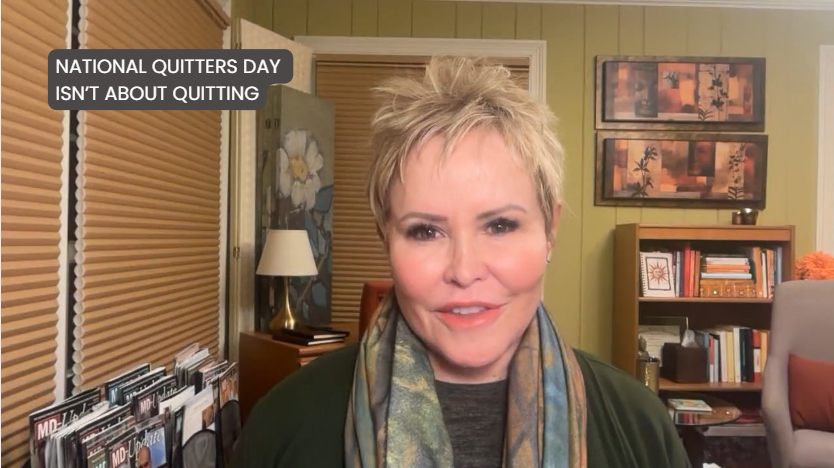

National Quitters Day Isn't About Quitting. It's About What You Tell Yourself Next
January 17th is National Quitters Day—that predictable moment when most New Year’s resolutions quietly fall apart.
As a psychologist and executive life coach, you know what I hate most about this day?

It’s not that people quit.
It’s what they tell themselves about why they quit.
"See? I'm weak.”
"I never follow through.
“What's wrong with me?”
That story?
That story does far more damage than the slip-up itself.
The Real Problem Isn't Lack of Willpower. It’s Not Understanding How Change Works.
Most people believe that if they just had better tools, the right mindset, or more grit, they’d finally fix the behavior they want to change—overeating, overspending, overreacting, overworking.
That belief sounds reasonable.
It’s also what quietly sets you up to fail.
Why? Because it misunderstands how habit change actually works.

The Autopilot Trap
(And Why Smart People Get Stuck)
Your brain’s autopilot is efficient by design. It handles routine behaviors so you don’t have to think about them.
The problem is that autopilot is currently in charge of handling your cravings.
So when a craving shows up—for a snack, a smoke, a scroll, or that pointed remark you’re dying to make — in those moments, it doesn’t feel like a choice at all. More like a reflex.
It spins up quickly, guided by old data and well-worn neural pathways, not by what you actually want in that moment.
No amount of self-lecturing fixes that.
What does help is interrupting autopilot long enough for fresh information to get in.
That pause? That’s your ticket back to freedom.
The Craving Tool (And the Big Myth That Trips People Up)
The framework I use comes from Dr. Judson Brewer, a neuroscientist and addiction psychiatrist, who developed the Craving Tool.
It’s an evidence-based approach to habit change that doesn’t rely on force, willpower, or Jedi mind tricks. It helps you interrupt that fast, reflexive habit loop when a craving or urge hits.
But not in the way you expect. There’s a mental trap, and no matter how smart you are, there’s a good chance you’ll fall for it. Here’s what it is and how to avoid it.
The Mental Trap:
“If I use this tool correctly, the craving will go away.”
Sometimes you’ll use the Craving Tool — and your craving will stop.
And ironically, that's where the trouble starts. Because it reinforces the wrong belief: The Craving Tool will make my craving go away.
Because when the craving doesn’t stop every time, people spiral:
You may blame yourself. "I'm not doing it right. What's wrong with me?"
You may blame the tool. "This stupid thing doesn't work.”
You may blame the person who gave you the tool. “She doesn’t know what she’s talking about."
All of it misses the point. And keeps you seriously stuck.

The Mental Reset: How Habit Change Actually Works
Here’s how habit change really works: The craving tool doesn’t stop or overpower the craving. It changes how you relate to those cravings and urges. So you can respond differently. That’s what changes everything.
How? The Craving Tool interrupts autopilot long enough for your brain to take a quick pause, re-evaluate, and emotionally regulate, so you have the freedom to choose versus reacting blindly. It puts you back in the driver’s seat.
Here’s the best part: No white-knuckling required. No force. No shaming. No self-attack. No Jedi mind tricks.
And it gets even better: The craving tool doesn’t just work in the heat of the moment. Even when it’s too late, and you’ve already screwed up, you can use the craving tool to go back into the experience and reprogram retrospectively. That’s how plastic your brain really is when you’re not freaking out or railing at yourself.
Why Your Brain Cares More About Your Body Than Your Inner Critic
Your brain doesn’t update habits through lectures or iron will.
Your brain needs body-based data— concrete, tangible input — physical sensations and emotions registering in your body— to update your mental software and upgrade to the best version of you.
Before you get too excited, know this: It takes time. Your brain is really smart and fast, but it takes small, repeatable steps to form and reinforce those new neural pathways. This isn’t instant, unsustainable change. It’s smart, sticky habit change.

When the Craving Doesn’t Go Away (This Is the Part Most People Skip)
Picture this: You’re on the couch, sitting in front of the TV. You know you're not really hungry, but you can't get rid of the food noise in your head.
So you pull up Dr. Jud’s Craving Tool. You go through the whole thing. You get to the end.
And you still want the snack.
The craving didn't shut down. The overpowering urge is still there.
What do you do?
Here's the counterintuitive move that changes everything:
You go ahead and eat it—just not on autopilot.
No judgment.
No self-lecture.
Just body-based awareness.
This isn’t giving up. It’s data collection.
Try It For Yourself: A Mindful Reset (Not a Resolution)
Use this tool when you have an urge to eat something:
Bring to mind the food you are struggling with.
Imagine eating the amount of food you usually eat.
Let it settle in your stomach. Now focus on what it feels like in your belly. Notice what your body feels like after you eat it.
Notice your thoughts and emotions.
Is the craving weaker? That’s a marker of body-based disenchantment and your brain predicting what will happen if you eat this type or amount of food based on your past experiences. By imagining eating the food first, you tap into your brain’s power to help weaken cravings — without willpower.
Is the craving still there? As you eat, check in with your body, thoughts, and emotions:
Pay attention to why you want to eat right now (hunger, emotions, boredom, etc.) No judgment, just data collection.
Pay attention to what you’re about to eat. What is it made up of? What does it look and smell like?
Pay attention as you eat each bite (taste, texture, temperature, etc.)
Keep paying attention until you finish eating.
What does your body feel like now?
What thoughts and emotions do you notice now?
Then debrief the experience. Ask yourself the following questions to bring awareness to the results of how, what and why you ate.
How much did you eat?
○ None ○ Too little ○ Right amount ○ Too much ○ Way too much
Check in with your body. How do you physically feel right now?
Awful -10 -5 0 +5 Awesome +10
Check in with your emotions. How do you feel right now?
Awful -10 -5 0 +5 Awesome +10
Check in with your thoughts. What are you telling yourself right now?
Unhelpful -10 -5 0 +5 Helpful +10
How rewarding was this eating experience?
Add up your results. A positive score suggests the eating experience was rewarding and a negative score suggests you are becoming disenchanted with the behavior.
What did you discover from this experience? You can bring what you learned from this experience to the next time you have a food craving.

The Real Win on National Quitters Day
National Quitters Day isn’t a failure checkpoint.
It’s a pivot point—especially if you’re exhausted from trying to force yourself into becoming your “best” self.
More discipline isn’t the missing piece.
Pushing harder isn’t either.
And shaming yourself into self-esteem just doesn’t work.
What helps is a clearer understanding of how change actually works.
Next time the urge hits—whether it's the third glass of wine, the sarcastic comment, or doom scrolling at midnight—try a tiny experiment with the Craving Tool. And let me know how it goes.
If you’re ready to stop white-knuckling your way through change, let’s talk.
Not about pushing harder.
About learning how to work with your brain instead of fighting it.
Book a no-cost, no-pressure consultation with me to start the conversation.