

What's Really Going On When You Keep Putting Things Off?
It's probably not laziness. It's something much more human.
Have you ever caught yourself thinking,
"Maybe now isn't the right time."
"I need to think about it a little longer."
"I don't know exactly what to say yet."
"Maybe I'll deal with it after I get this crazy-busy week out of the way."
Sometimes those are wise decisions. Timing really does matter.
Sometimes, though, "waiting for the right moment" is simply that little burst of relief that comes from putting something off.
When most people hear the word procrastination, they think about unfinished projects, overdue paperwork, or the closet they've been meaning to clean out. I used to think that way too.
I've realized that some of the most important things I put off aren't chores at all. They're difficult conversations with people I care about, tough business decisions I know I need to make, scheduling a medical appointment, saying no to a request, or reaching out after a misunderstanding.

Procrastination often isn’t a time-management problem.
It’s an emotion-regulation problem.
We put things off not because we’re lazy, but because some part of us expects the task to feel difficult, overwhelming, uncomfortable. The shift is to stop asking, “What’s wrong with me?” and let your Inner CEO ask, “What’s really going on here?”—then make the next step easier to take.
Did I mention I have a lot of experience putting things off?
My husband is what I jokingly call a certified pre-crastinator—someone who gets things done as early as humanly possible. When I told him I was writing an article about procrastination, he laughed.
"Well, you're writing about something you certainly know a lot about."
He wasn't wrong.
Fortunately, the more I learn about how my brain works, the easier it's becoming to interrupt the putting-things-off cycle—or at least shorten the amount of time I spend there.
That shift began when I came across a piece of research that completely changed the way I think about procrastination.
Putting things off isn't a time-management problem.
It's an emotion-regulation problem.
I remember reading that and thinking, "Well...that explains a lot."
If putting things off is really an emotion-regulation problem, maybe the solution isn't just trying harder—or downloading another productivity app. Maybe it's learning how to respond differently to the emotions that make me want to avoid the task in the first place.
That realization has made me start paying closer attention to what’s happening inside my own head whenever I find myself putting something off.
What I’ve discovered is surprising.
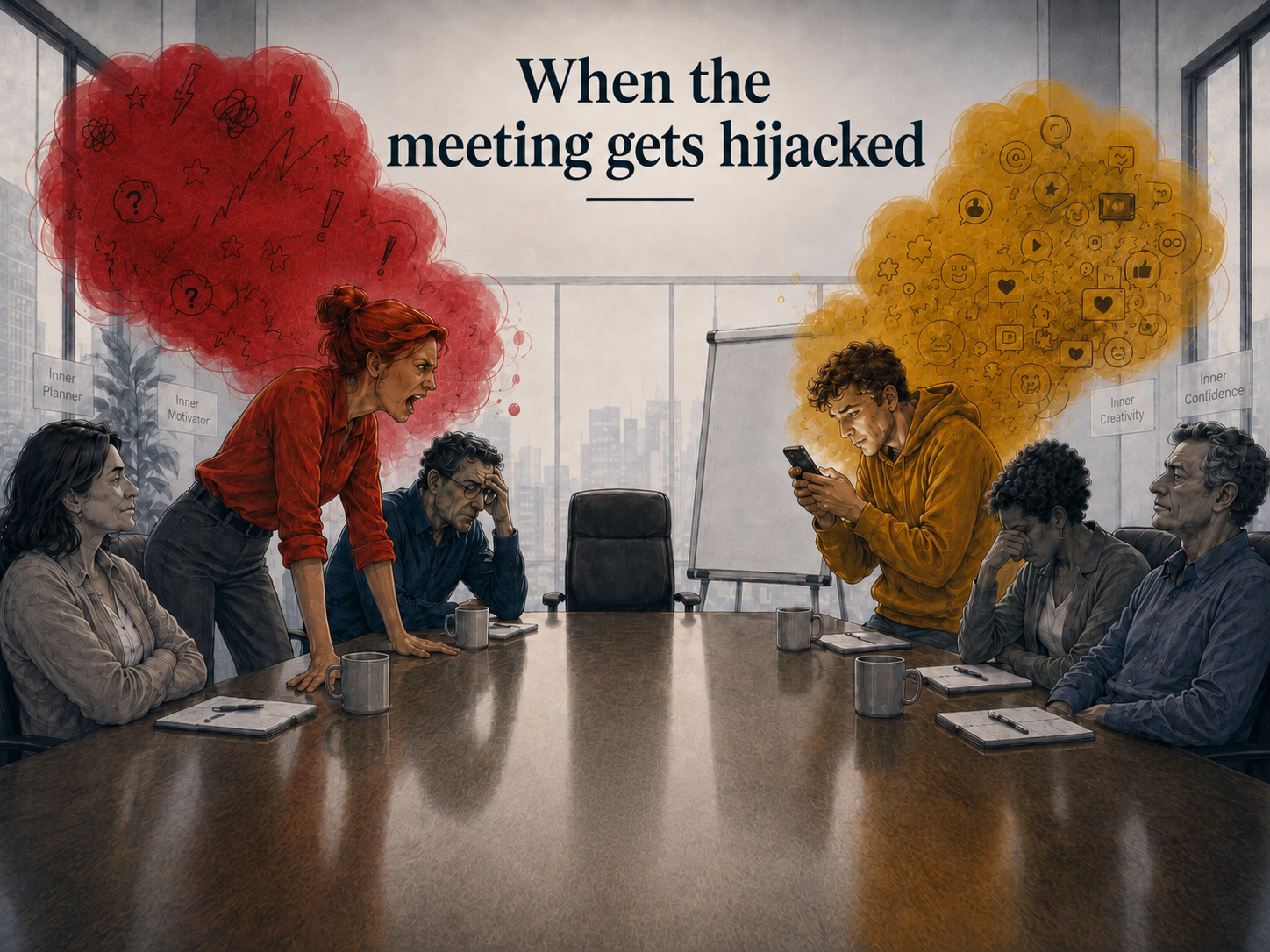
There isn't just one voice in my head. There are several, and they don’t always agree.
I’ve started thinking of them as the Committee Members in My Head.
"What's Wrong with You?": The Inner Critic
Like a lot of committee meetings, the loudest voice usually speaks first.
Mine is the Inner Critic. And it doesn't waste any time making its case.
"You're so scattered."
"You should have started this days ago."
"Why can't you just be more disciplined?"
For years, I assumed my Inner Critic was telling me the truth. Now I realize it’s desperately trying to motivate me. It just uses a terrible strategy.
I've never found shame to be a very effective motivator. If anything, it usually has the opposite effect. After a good shame attack, I often need time just to recover before I can even think about taking the next step.
These days, the more I pay attention, the more I realize my Inner Critic doesn’t hate me and it isn't trying to make me miserable. It’s just trying to help me get moving and mistakenly believes that berating me is the fastest way to make that happen.
That's when I started wondering if maybe I don't need a louder Inner Critic.
Maybe I need another committee member who understands something the Inner Critic doesn’t.
"It’s Going to Be Really Bad": The Inner Doomscroller
That’s when another voice quietly clears its throat.
I call this committee member my Inner Doomscroller.
I've come to think of it as the part of my brain that doesn't just doomscroll the news. It doomscrolls my future.
Its job is to scan for danger, and that's not a flaw—it's part of our evolutionary heritage. The human brain evolved to keep us alive, not necessarily to keep us comfortable. Today, though, my Inner Doomscroller can react to a difficult conversation, a challenging project, or an uncomfortable decision as something to avoid.
In many ways, my Inner Doomscroller is simply doing the job it was designed to do. The problem is that it doesn't always know when to stop. One reasonable concern can quickly turn into a dozen imagined disasters.
It starts with one perfectly reasonable concern, then just keeps scrolling.
"This is going to be really hard."
"This is going to take forever."
"This is going to feel awful."
"There's no way I can get this done on time."
The first time I listened to that voice, something finally clicked.
Maybe I’m not putting things off because I’m lazy or incompetent. Maybe I’m putting them off because my Inner Doomscroller had done such a good job convincing me the experience is going to feel awful.
If I've already convinced myself it’s going to be miserable, why should I be eager to begin?
That's when I realized that more than avoiding the task, I’m avoiding how I expect the task to feel.
No wonder putting it off feels like such a relief, at least temporarily.
The more I think about it, the more I realize my Inner Doomscroller isn't trying to sabotage me. Like my Inner Critic, it’s trying to help me. It just has a very different strategy. Instead of criticizing me into action, it tries to protect me by steering me away from anything that might feel difficult or uncomfortable.
The problem was that it sometimes tries a little too hard to protect me from those feelings.

"What's Really Going On Here?": The Inner CEO
These days, when I find myself asking, "What's wrong with me?" I’m starting to follow it up with a different type of question:
"What's really going on here?” “What’s the real problem?”
That question changes the entire committee meeting. Not because it immediately solves the problem, but because it completely changes the conversation in the room.
Before, every committee member had been trying to convince me of something. The Inner Critic wanted me to believe I wasn't trying hard enough. The Inner Doomscroller wanted me to believe the task was too uncomfortable or too overwhelming.
Nowadays, it’s easier to access another committee member. It’s not louder or smarter. It’s simply...different.
I've come to think of that voice as my Inner CEO. Unlike the other committee members, my Inner CEO isn't interested in blaming or beating anyone up. It's genuinely interested in understanding what's really going on.
One thing I've learned from working with executives over the years is that the best leaders don't rush to solve the problem. They slow the conversation down just long enough to understand what the real problem is before deciding what to do next. That's exactly what my Inner CEO does.
Instead of reacting to the loudest or most anxious voice in the room, it asks three simple questions:
What's really going on here?
What's the real problem?
Are we missing anything?
Then it waits.
It listens.
The Inner Critic gets to explain what it's worried about. The Inner Doomscroller can explain what it's trying to protect me from feeling. Instead of arguing with either one, my Inner CEO gets genuinely curious.
"Help me understand."
That simple question changes everything.
One of the biggest surprises for me has been discovering that the committee member creating the most resistance often has the most useful information.
For example, my Inner Doomscroller might say,
"I'm not just afraid of getting started. I'm afraid that once we start cleaning the closet, we won't be able to stop. We'll spend the whole afternoon on it and fall behind on everything else."
Suddenly, the problem isn't procrastination anymore.
The problem is feeling trapped.
Once my Inner CEO understands that, the conversation naturally shifts from arguing about whether to move forward to negotiating how to move forward.
Instead of saying, "Don't be ridiculous. Just get started," my Inner CEO asks,

"What are you trying to accomplish?"
The Doomscroller can now think for a moment before answering.
"I don't want us to lose the whole afternoon. I'd feel much better if I knew we could stop after fifteen minutes, only had to organize one shelf, and didn't have to finish the whole thing today."
Now my Inner CEO has something it didn't have before.
A problem it can actually solve.
I’ve found this isn’t just true when I’ve been putting things off. It’s often true in any difficult decision or conversation I face. The moment I become genuinely interested in understanding what each part of me is trying to accomplish, I automatically start making better decisions.
That's what the best leaders do. They don't silence the people who disagree with them. They listen long enough to understand what each person is trying to protect or accomplish, reframe the problem, negotiate a plan that takes into account everyone's legitimate concerns, and then decides how to move forward.
I’ve realized the Committee Members in My Head aren't just a clever metaphor. They give me a practical way to regulate the emotions that can keep me stuck.

"How Can I Help?": The Inner Coach
The Inner Coach has one job: to help us come up with a plan everyone can actually get behind.
I've noticed my Inner Coach has a completely different motivational style than my Inner Critic. The Inner Critic believes shame creates motivation. My Inner Coach knows that support creates momentum.
Instead of asking, "What's wrong with you?" or predicting, "This is going to be awful," it asks a much simpler question:
"How can I make this easier for us?"
Sometimes the answer is surprisingly simple. We open the document. We ask for help. We write one paragraph. We make one phone call. We organize one shelf. We stop after fifteen minutes if that's what we agreed to do.
We're not trying to accomplish everything today.
We're simply taking the next step together.
I've found that meaningful progress rarely begins with giant leaps. More often, it begins with practical self-support and one manageable step.
Interestingly, researchers have found that people who respond to themselves with greater self-compassion after procrastinating are actually less likely to procrastinate the next time. That finding makes perfect sense to me. Support has always gotten me moving more effectively than shame.
"Who's Running the Meeting?"
The next time I catch myself putting something off, I hope I'll remember to call an Inner Committee Meeting.
I'll listen to what each committee member is trying to accomplish before I decide what to do. I've learned not to assume the committee member creating the biggest problem is the problem. More often than not, it's pointing me toward the real problem.
Once everyone has been heard, my Inner CEO can understand the problem, reframe it, negotiate a workable plan, and ask my Inner Coach to help us carry it out.
Maybe the next time you catch yourself putting something off, you'll remember to call an Inner Committee Meeting, too.
I've stopped trying to get rid of the difficult committee members. I’m learning to listen to them before I try to lead them. Every committee member has a unique perspective, an important job to do and needs to be heard. I just don't want any one of them running the meeting.

That's my Inner CEO's job.
When my Inner CEO runs the meeting, moving forward becomes a whole lot easier.
If this brought something into focus—at work, in a relationship, or just in yourself—I offer brief, no-pressure consultations. We can quickly sort through what’s happening and zero in on what would help move things forward.
Let’s see what a better move might look like.
